

If you’ve ever watched a detective show on television, you might think private investigators have access to one magical database that instantly reveals everything about a person. On the other hand, you may have heard people say investigators have no special access at all and simply search the internet like everyone else.
The truth falls somewhere in the middle.
Licensed private investigators are granted lawful access to proprietary databases and investigative resources that are not available to the general public. Many of these resources are also available to law enforcement agencies and contain information that can significantly assist an investigation. However, no single database contains every answer, and even the best investigative resources have limitations.
Successful investigations rarely depend on one search alone. Instead, they rely on combining information from many different sources, along with experience, public records, proprietary databases, interviews, surveillance, open-source intelligence, and careful analysis. Knowing where to look is only part of the equation. Knowing how to interpret the information and connect the pieces is what often leads to answers.
At Proven Private Investigators, one of the most common questions we hear is, “Can you find out…?”
Sometimes the answer is yes. Sometimes it’s no. And sometimes the answer depends on the circumstances.
It’s also important to remember that the laws governing private investigators vary from state to state. The information in this article is intended as a general overview and may not apply in every jurisdiction. In many situations, what a private investigator can legally do depends not only on the law where the investigation takes place, but also on the specific facts of the case.
Below are answers to seven of the questions people ask us most often.
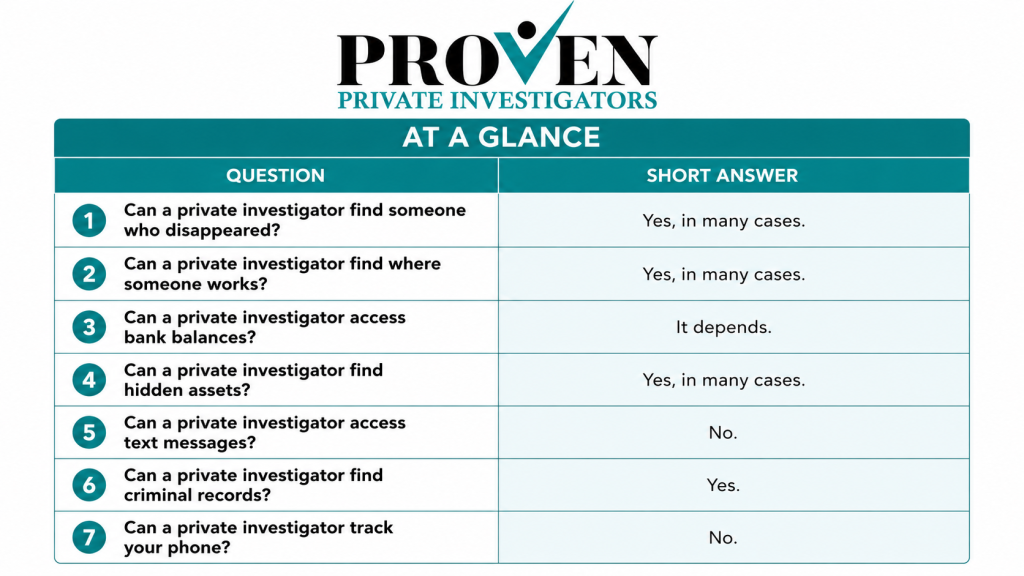
Can a Private Investigator Find Someone Who Disappeared?
Short answer: Yes, in many cases.
People lose touch for all kinds of reasons. A family member may move across the country without leaving a forwarding address. A witness may become difficult to locate before a court hearing. Someone who owes money may intentionally disappear to avoid paying a debt. Sometimes people simply change jobs, move to a new city, get married, or stop using social media.
Locating people is one of the most common services private investigators provide. This type of investigation is commonly referred to as a skip trace.
During a skip trace, investigators gather information from many different lawful sources. Depending on the circumstances, this may include proprietary investigative databases, public records, court filings, property records, business records, professional licenses, and publicly available online information. Every piece of information is treated like a puzzle piece. On its own, it may not tell us much. When combined with other information, it often points us in the right direction.
For example, someone may have sold a home several years ago, recently registered a business, updated a professional license, or appeared in a new court filing. Individually, those records may seem unrelated. Together, they may help establish where someone is currently living or working.
Of course, not every search ends successfully. Some people intentionally take extraordinary steps to remain hidden, while others leave very little information behind. Even so, experienced investigators are often able to locate people that friends, family members, attorneys, or creditors have been unable to find on their own.
Whether you’re trying to locate a missing family member, a witness, someone who needs to be served with legal documents, or a judgment debtor, hiring a private investigator often provides access to resources and investigative techniques that simply aren’t available to the average person.
Can a Private Investigator Find Where Someone Works?
Short answer: Yes, in many cases.
Employment information can be valuable in a wide variety of situations. An attorney may need to verify employment before seeking a wage garnishment. Someone attempting to collect on a civil judgment may need to know where a debtor works. Employment verification may also become important in family law matters, fraud investigations, or background investigations.
One advantage licensed private investigators have is lawful access to proprietary investigative databases that are not available to the general public. Depending on the information available, these systems will often indicate whether an individual has records associated with a particular employer. These databases receive information from numerous lawful sources, including data connected to the credit reporting industry. While they can often help identify employment information, they do not provide access to a person’s credit score or complete credit report.
Like every investigative tool, these databases are not perfect.
People change jobs. They become self-employed. They retire. They work remotely. Sometimes employment information simply hasn’t been updated yet.
When that happens, investigators may rely on additional investigative techniques, including surveillance, public records research, interviews, and other lawful methods to verify where someone is employed.
The goal isn’t simply to guess where someone works. It’s to develop reliable information that can be documented, verified whenever possible, and used appropriately within the purpose of the investigation.

Can a Private Investigator Access Bank Balances?
Short answer: It depends.
This is one of the biggest misconceptions about private investigators.
Television often portrays investigators as people who can instantly hack into someone’s bank account and view every account they own along with every dollar they have.
That simply isn’t true.
Private investigators cannot log into someone’s bank account, access financial records whenever they choose, or view bank balances simply because a client asks them to.
However, there are limited situations where bank balance information may become legally available.
For example, in certain jurisdictions and under very specific legal circumstances, a private investigator working on behalf of a judgment creditor may be able to assist with locating bank account information or obtaining account balances as part of a lawful judgment collection process. These situations generally require an active court judgment and must follow strict legal procedures established by law.
These circumstances are the exception, not the rule.
Because the laws governing these types of investigations vary from one jurisdiction to another, the answer depends heavily on where the investigation is taking place and the specific facts of the case.
The important thing to remember is this: private investigators do not have unrestricted access to everyone’s financial information. When bank balance information becomes available, it is because the law specifically permits it under very limited circumstances.
That distinction is an important one, and it’s one that separates legitimate investigators from the fictional versions often seen on television.

Can a Private Investigator Find Hidden Assets?
Short answer: Yes, in many cases.
When people hear the phrase “hidden assets,” they often picture stacks of cash hidden under a mattress or buried somewhere in a backyard.
Real asset investigations usually look very different.
In many cases, the goal is to identify assets that someone may not have disclosed or that another party simply didn’t know existed. Depending on the purpose of the investigation, this may include real estate, businesses, corporate ownership interests, vehicles, watercraft, aircraft, or other publicly identifiable assets connected to an individual or business.
Asset investigations are commonly requested during divorce proceedings, partnership disputes, estate matters, business litigation, and judgment collection cases.
Finding assets requires much more than running a quick database search.
Experienced investigators know that people often own property through corporations, limited liability companies, trusts, or other legal entities. Following those connections requires patience, attention to detail, and an understanding of how ownership records are created and maintained.
It’s also important to understand what an asset investigation is not.
Private investigators identify and document information. We do not seize property, freeze bank accounts, or recover assets ourselves. Those legal remedies, when available, typically occur through attorneys and the court system.
Sometimes an asset investigation uncovers significant property that a client didn’t know existed. Other times, it confirms there are very few assets to pursue. Both outcomes provide valuable information because they allow clients and their attorneys to make informed decisions before investing additional time and money into legal proceedings.
Can a Private Investigator Access Text Messages?
Short answer: No.
This is another question we hear all the time, largely because television and movies make it seem like reading someone else’s text messages is as easy as pressing a few buttons on a computer.
Real life doesn’t work that way.
Legitimate private investigators cannot hack into someone’s phone, intercept text messages, or secretly access private conversations simply because someone hires us to do so.
If someone claims they can, that’s a major red flag.
Professional investigators operate within the law. Accessing another person’s private communications without proper legal authority can violate both state and federal laws, and any information obtained illegally may be unusable in court.
Fortunately, reading someone’s text messages is rarely necessary to answer the questions our clients are asking.
Instead, investigators rely on lawful investigative techniques such as surveillance, interviews, public records research, social media analysis, open-source intelligence, and proprietary investigative databases to develop the information needed.
In many cases, these methods provide a much clearer picture than a handful of text messages ever could.
The best investigations aren’t built on illegal shortcuts. They’re built on patience, experience, and gathering information that can withstand scrutiny if the matter ever reaches a courtroom.
Can a Private Investigator Find Criminal Records?
Short answer: Yes.
Criminal history investigations are among the most requested services private investigators perform. However, there’s a common misconception that finding criminal records is simply a matter of typing someone’s name into Google or purchasing an inexpensive online background check.
In reality, it’s much more complicated than that.
Unlike what many people believe, there is no single nationwide database that contains every criminal case filed in the United States. Criminal records are maintained by thousands of individual courts and government agencies, each with its own procedures, search methods, and record systems.
Some counties make records available online. Others require records to be requested in person. Some states maintain statewide repositories, while others rely heavily on county-level records. Federal criminal cases are maintained in an entirely different court system.
Knowing where to search is often just as important as knowing how to search.
But even after you’ve found the records, another challenge begins.
Understanding what actually happened.
Imagine downloading a court docket and seeing entries that look something like this:
- “Complaint Filed.”
- “Arraignment Held.”
- “PC 459(a).”
- “Plea Entered.”
- “Sentencing Continued.”
- “Execution of Sentence Stayed.”
- “Probation Granted.”
To someone without experience reading court records, those entries can feel like a different language.
Was the person convicted?
Were the charges dismissed?
Did they go to jail?
Did they plead guilty to a lesser offense?
Were they found not guilty after a trial?
Did they complete probation successfully?
The answers aren’t always obvious from the court record alone.
That’s where a professional investigator adds real value.
Our job isn’t simply to locate court records. It’s to review those records, understand the legal process they document, and explain the outcome in plain English.
Instead of handing a client dozens or even hundreds of pages filled with legal terminology, abbreviations, minute orders, and court filings, we help tell the story. We explain what happened, why it happened, and how the case ultimately ended based on the records available.
That difference can be incredibly important when attorneys, employers, businesses, or private individuals are making decisions based on someone’s history.
Can a Private Investigator Track Your Phone?
Short answer: No.
Movies often show investigators tracking someone’s cell phone in real time using sophisticated software.
That isn’t how legitimate private investigators operate.
Private investigators cannot legally access your phone’s live location simply because someone hires us to do so.
Cell phone location information is protected by law and is generally available only through the phone’s owner, the wireless carrier, or lawful legal process.
That doesn’t mean investigators can’t determine where someone has been.
Instead, investigators often use lawful surveillance, public records, interviews, observations, and other investigative techniques to document a person’s activities.
In many cases, these traditional investigative methods provide far more reliable information than people expect.
While television often portrays investigations as being driven by advanced technology, most successful investigations are actually built on careful observation, thorough research, and connecting small pieces of information over time.
Sometimes the old-fashioned investigative techniques are still the most effective.
Every Investigation Starts with the Right Question
Almost every investigation begins the same way.
Someone has a question.
Maybe they’re trying to locate a missing family member.
Maybe they’re wondering whether someone has hidden assets.
Maybe they’re trying to verify employment before collecting on a judgment.
Or maybe they simply want to understand someone’s background before making an important personal or business decision.
Whatever the reason, most conversations begin with a simple question:
“Can you find out…?”
Sometimes the answer is yes.
Sometimes the answer is no.
And sometimes the answer depends on the specific facts of the case, the laws that apply, and the purpose of the investigation.
What people often discover is that the real value of hiring a private investigator isn’t access to a magical database or secret technology.
It’s experience.
It’s knowing where to look.
It’s knowing how to separate accurate information from outdated information.
And perhaps most importantly, it’s knowing how to take dozens of small pieces of information and put them together into a complete, understandable picture.
At Proven Private Investigators, we believe every investigation should be conducted legally, ethically, and thoroughly. Whether you’re trying to locate someone, verify employment, conduct a background investigation, identify assets, or simply determine whether an investigation may be worthwhile, we’re happy to discuss your situation and explain what may be possible.
Sometimes, the answers you’re looking for are closer than you think.
It all starts by asking the right question.
Disclaimer: Proven Private Investigators is not a law firm and does not provide legal advice. Nothing in this article should be interpreted as legal advice or as a guarantee that specific information can be obtained in every case. Laws governing private investigators vary by state and may change over time. The availability of information often depends on the jurisdiction, the facts of the case, and the purpose of the investigation. If you need legal advice regarding your specific situation, you should consult a qualified attorney.