

If television has taught us anything about private investigators, it is that we apparently spend our days wearing disguises, hiding behind newspapers with eyeholes cut out, and dramatically appearing at exactly the right moment to catch someone in the act.
Reality is a little different.
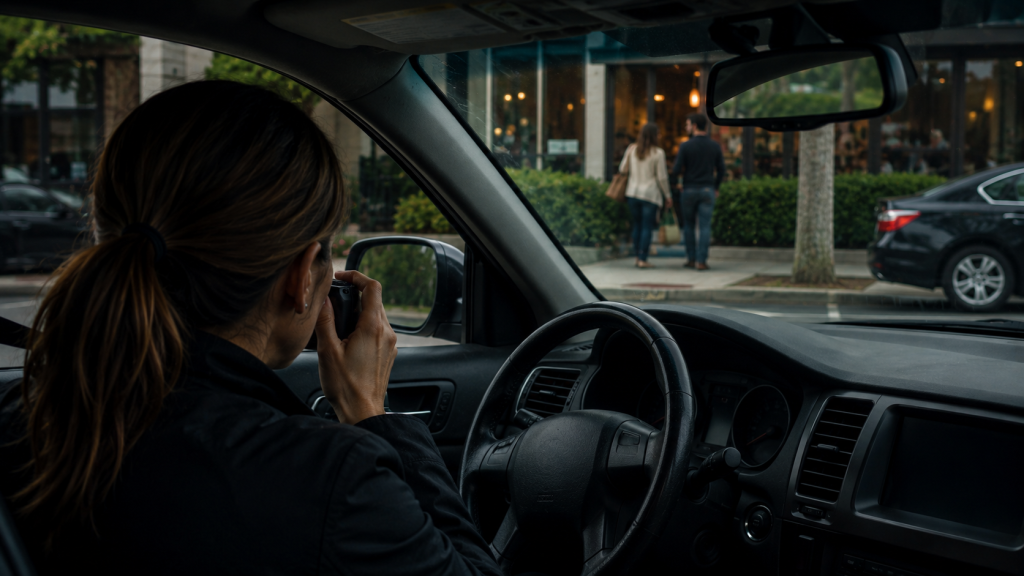
Private investigators really do conduct investigations involving suspected infidelity, and surveillance is often the primary tool used to gather information. However, there is usually much less dramatic music involved, and nobody can guarantee that an investigation will end with a perfectly timed photograph worthy of a television season finale.
People often contact private investigators because something does not feel right. A spouse may suddenly be working unusual hours, spending more time away from home, becoming unusually protective of their phone, or offering explanations that simply do not seem to add up. Sometimes there is a specific person involved. Other times, there is nothing concrete at all, just a growing sense that something has changed.
That is often where a private investigator comes in.
But can an investigator really catch a cheating spouse? Will the person know they are being investigated? Can a private investigator legally follow someone? And what happens if surveillance does not immediately provide answers?
Let’s separate television fiction from the reality of a cheating spouse investigation.
Can a Private Investigator Catch a Cheating Spouse?
Yes, a private investigator may be able to catch a cheating spouse. However, there is an important distinction between conducting an investigation and guaranteeing a particular result.
A private investigator cannot make someone cheat, schedule an affair for Tuesday afternoon, or politely request that suspicious behavior occur during business hours.
Investigators work with the circumstances that actually exist.
When someone hires a private investigator to investigate suspected infidelity, the goal is generally to gather factual information and document observable activity. Surveillance may reveal that the person’s behavior is entirely innocent. It may reveal information that explains why the client had concerns. Or it may document activity that supports suspicions of infidelity.
The outcome depends entirely on what the investigation uncovers.
This is one area where real life differs significantly from television. On television, the investigator receives a case on Monday, follows someone on Tuesday, takes one perfectly framed photograph on Wednesday, and presents irrefutable evidence before the commercial break.
In real life, investigations can be much less predictable.
A person may behave differently from one day to another. They may have a routine that changes unexpectedly. They may spend an entire surveillance period doing nothing particularly interesting. And sometimes, despite legitimate concerns, an investigation simply does not uncover evidence that the person is involved in a relationship outside the marriage.
That does not necessarily mean the investigation was unsuccessful.
A professional private investigator documents what actually happens, not what a client hopes or expects to find. Sometimes the information gathered provides confirmation. Sometimes it provides reassurance. Either way, factual information can help replace uncertainty with a clearer understanding of the situation.
Surveillance is typically the primary way a private investigator attempts to catch a cheating spouse because it allows the investigator to observe and document a person’s activities in real time. Depending on the circumstances, surveillance may reveal where someone goes, who they meet, how long they remain at a location, and whether patterns of behavior emerge.
Of course, conducting surveillance raises another question that many clients ask before the investigation even begins.
Will the person know?
Will a Cheating Spouse Know They Are Being Investigated?
One of the most common questions people ask is whether their spouse will know they are being investigated.
The honest answer is that a professional investigator generally takes reasonable steps to conduct an investigation without unnecessarily drawing attention to the surveillance. However, no legitimate investigator should guarantee that a person will never become aware of an investigation.
People notice things.
Someone may become suspicious for reasons entirely unrelated to the investigator. They may already know their spouse has concerns. They may change their routine unexpectedly. Or they may simply become more observant.
A private investigator’s goal is not to announce their presence with a flashing sign that says, “Good afternoon, I am here to observe your activities.”
Professional surveillance requires patience, awareness, and the ability to adapt to changing circumstances. An investigator must make decisions based on the environment and the activities taking place at the time.
This does not mean private investigators wear elaborate disguises or transform themselves into entirely different people every morning.
Contrary to popular television portrayals, professional surveillance does not typically involve a collection of wigs in the trunk of a vehicle.
The reality is usually far less theatrical.
Investigators rely on experience, observation, planning, and situational awareness. Surveillance may involve periods of waiting, observing a location, documenting activity, or following a person when circumstances permit. There may be long stretches where nothing happens at all.
And yes, sometimes the most exciting part of surveillance is wondering whether the person being observed will ever leave the grocery store.
A good investigator also understands that avoiding unnecessary attention is only one part of the job. The investigation must still be conducted lawfully and professionally. Trying to remain unobtrusive does not give an investigator permission to trespass, invade someone’s private space, or engage in unlawful conduct.
The purpose is to observe and document information that can legally and ethically be obtained.
This naturally leads to another question: Can a private investigator actually follow someone suspected of cheating?
Can a Private Investigator Follow a Cheating Spouse?
In many circumstances, a private investigator may lawfully follow and observe a person in public places as part of a surveillance investigation. However, exactly what an investigator can do depends on the circumstances and applicable laws.
Surveillance is typically the primary investigative method used when someone wants to catch a cheating spouse.
Why?
Because surveillance allows an investigator to observe what a person actually does rather than relying solely on assumptions, rumors, or suspicions.
A private investigator may observe a person leaving a residence, traveling to another location, meeting someone, entering a restaurant, or spending time at a particular place. The investigator may document relevant observations through written reports, photographs, or video when lawfully appropriate.
The emphasis is on observable activity.
A private investigator does not have magical access to someone’s thoughts, intentions, or private conversations. If someone meets another person for dinner, the investigator can document the meeting. The investigator cannot simply declare what the relationship means.
That distinction is important.
Professional investigators document facts. Clients can then consider those facts in the broader context of their situation.
Following someone during surveillance is also not as simple as it appears in movies. The investigator cannot assume that every person will travel conveniently through lightly populated streets while remaining completely unaware of their surroundings.
Real-world surveillance can involve traffic, changing routes, crowded parking lots, unexpected stops, and people who suddenly decide that today is the perfect day to visit three stores they have not entered in six months.

An investigator must continually assess the circumstances.
More importantly, surveillance is not unlimited.
Private investigators must operate within legal boundaries. A cheating spouse investigation does not give an investigator permission to enter private property without authorization, access private accounts, hack into a phone, install spyware, or secretly obtain information that the investigator is not legally entitled to access.
Hollywood may occasionally suggest that a determined investigator can access anything with enough dramatic keyboard typing.
That is not how legitimate private investigations work.
When clients are considering whether to hire someone to catch a cheating spouse, it is important to work with a properly licensed professional who understands the legal and ethical limitations of an investigation.
Following and observing someone may be an important part of the process, but surveillance is not necessarily the only way investigators gather information.
How Do Private Investigators Investigate a Cheating Spouse?
Although surveillance is typically the primary method used in a cheating spouse investigation, it is not always the only source of information.
Every investigation is different.
Before an investigation begins, a private investigator will often gather information from the client about the circumstances that led to their concerns. This may include information about the person’s normal routine, work schedule, vehicles, frequently visited locations, or dates and times when unusual behavior has occurred.
This information can help the investigator understand the situation and determine when surveillance may be most productive.
For example, a client may explain that their spouse has recently begun leaving the house at unusual times every Thursday evening. Or perhaps the person regularly claims to be working late but returns home at inconsistent times.
That information does not prove anything.
However, it may help identify potential opportunities for surveillance.
Investigators may also review publicly available information when appropriate and relevant to the case. Depending on the circumstances, this may include information that is lawfully available through public records or other legitimate investigative resources.
Publicly available online information may also provide useful context in some cases.
However, there is an important misconception about private investigators that is worth addressing here: Hiring a private investigator does not provide unlimited access to another person’s private life.
A private investigator cannot legally access someone’s private text messages simply because a spouse suspects cheating. An investigator cannot hack into a social media account, guess a password, or secretly access private communications.
There is a significant difference between reviewing information that is legally available and unlawfully accessing private information.
A professional investigation stays on the right side of that line.
Information gathered before and during an investigation may also help identify patterns. Patterns can be important because individual events do not always provide meaningful answers.
Someone having dinner with another person on one occasion may be completely innocent. Repeated meetings at unusual times or locations may provide additional context. Again, the investigator’s role is not to speculate about what the behavior means.
The investigator documents what can actually be observed.
This is why surveillance remains so important. While other information may help provide context, surveillance can allow an investigator to independently observe and document activities as they occur.
In many cases, the client has already spent weeks or months trying to make sense of small changes in behavior. They may have noticed inconsistencies but have no way to determine whether those inconsistencies are significant.
An investigation can help replace guesswork with documented information.
Of course, one of the biggest practical questions remains: How long does all of this take?
Unfortunately, private investigators do not have a crystal ball.
How Long Does a Cheating Spouse Investigation Take?
There is no single answer to how long a cheating spouse investigation will take.
Some investigations may provide useful information relatively quickly. Others may require multiple surveillance periods over several days or weeks.
The length of the investigation depends on many factors, including the person’s routine, the information available to the investigator, and whether suspicious activity occurs during the times surveillance is conducted.
An investigator cannot control another person’s schedule.
Someone may engage in suspicious activity regularly. Someone else may only meet another person occasionally. A person may change their routine without warning. Plans may be canceled. Weather, traffic, work obligations, and completely ordinary life can all affect what happens during surveillance.
There is also no guarantee that suspicious activity will occur during the first surveillance period.
This is another area where television has created unrealistic expectations.
On television, the investigator usually begins surveillance at 8:00 a.m., follows the person for approximately twelve minutes, and immediately discovers everything there is to know.
Real surveillance often requires considerably more patience.
Sometimes a surveillance period produces significant information. Other times, the person goes to work, stops for gas, buys groceries, and returns home.
That may not be exciting, but it is still information.
It can help establish routines and identify patterns that may become relevant later.
The information provided by the client can also affect how efficiently an investigation is conducted. If the client knows that unusual behavior tends to occur on specific days or at particular times, that information may help the investigator focus surveillance efforts more strategically.
However, even the best information does not guarantee that an investigator will immediately catch a cheating spouse.
A professional investigator should be honest about that.
The purpose of an investigation is not to create a predetermined outcome. It is to gather factual information based on lawful investigative methods.
The Reality of Trying to Catch Cheating Spouses
Sometimes that information confirms a client’s concerns. Sometimes it does not. Sometimes the investigation reveals an explanation that the client had not considered.
While television may make cheating spouse investigations look simple, real investigations require patience, experience, careful observation, and a commitment to documenting facts.
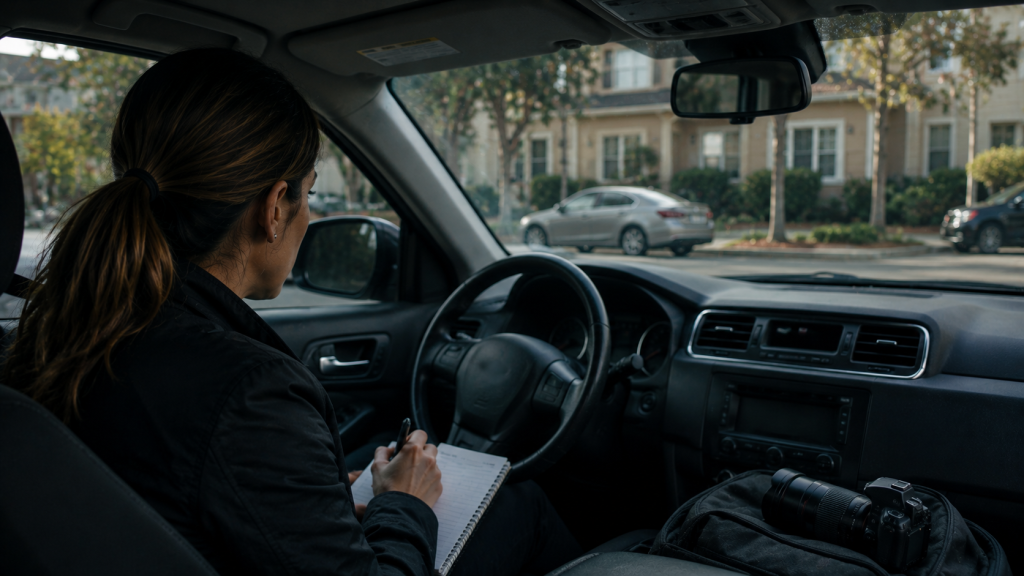
There may be no dramatic confrontation. There may be no perfectly timed photograph. And thankfully, there is usually no dramatic soundtrack playing in the background.
But private investigators can play an important role when someone has legitimate concerns and wants factual information rather than continued uncertainty.
If you are considering hiring a private investigator to catch a cheating spouse, it is important to work with a qualified professional who understands how to conduct surveillance and other investigative activities lawfully, discreetly, and professionally.
At the end of the day, a private investigator cannot promise what an investigation will uncover.
What they can do is investigate the facts.