

Child custody disputes can be painful. A child custody investigation may be considered when one parent is worried about what happens while the child is with the other parent. Concerns may involve drug use, unsafe driving, poor supervision, or the people spending time around the child.
Sometimes, the parents tell very different stories. One parent may say that everything is safe and normal. The other may believe that the child is being placed at risk. Without proof, it can be hard for an attorney or judge to know what is truly happening.
A child custody investigation can help document facts. A licensed private investigator may conduct surveillance, research public records, identify people around the child, or interview witnesses. The investigator’s job is not to choose sides. The goal is to gather clear and lawful information about the child’s care, safety, and surroundings.
This type of investigation is different from a court-ordered child custody evaluation. In California, a custody evaluation is usually completed by a trained mental health professional appointed by the court. The evaluator studies the child’s health, safety, welfare, and best interests. The evaluator may meet with the parents and children and make recommendations to the court. The California Courts Self-Help Guide provides more information about that process.
A privately hired investigator has a different role. The investigator is usually hired by a parent or family law attorney to look into specific concerns and document facts. The investigator does not perform psychological testing, decide who should have custody, or replace the work of an attorney or court-appointed evaluator.
What Is a Child Custody Investigation?
A child custody investigation is a fact-finding process that is built around a specific concern for a child’s safety or well-being. There is no single approach used in every case. A parent or attorney may hire a licensed private investigator to look into the exact concerns at hand, such as unsafe supervision, substance use, reckless driving, violations of a custody order, or the people spending time around the child.
The investigation should have a clear purpose. It should not be used to upset the other parent, interfere with parenting time, or search for minor faults. No parent is perfect. The goal is to find facts that may matter to the child’s health, safety, and welfare.
A private child custody investigation may include:
-
Surveillance from lawful public locations
-
Photographs or video of activities seen in public
-
A criminal record search
-
Research into adults who spend time around the child
-
Review of addresses, vehicles, and public records
-
Interviews with witnesses
-
Documentation of custody or visitation order violations
-
A written report of the investigator’s observations
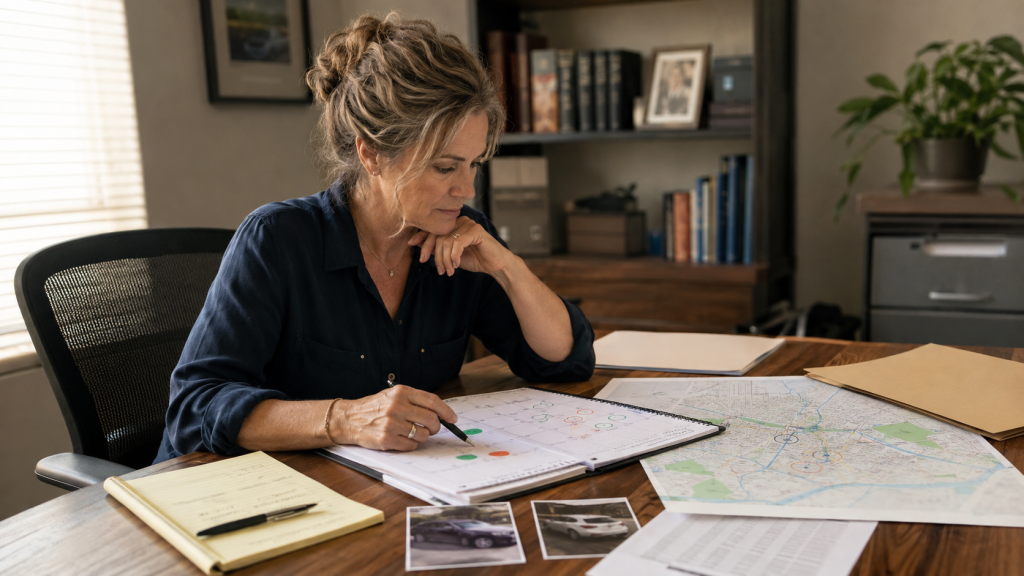
The exact plan will depend on the concern. For example, a parent may believe the other parent is driving with the child after drinking. In that case, surveillance during exchanges or parenting time may help show where the parent goes and how the parent drives.
Another parent may be worried about an unknown adult living in the home. An investigator may research that person’s identity, address history, criminal court records, or other public information.
There is an important limit. A private investigator can only report what can be lawfully found or observed. An investigator cannot enter a home without permission, record private conversations unlawfully, hack into an account, or force someone to answer questions.
The investigator must also remain neutral while reporting the facts. If the concern involves unsafe conduct or compliance with a specific term of the custody order, the report should document evidence directly related to that issue and describe only what the investigator observed. Counsel can then review and present the evidence, and the court can decide what findings, if any, should be made. The investigation may support the concern, fail to support it, or produce mixed results.
What Does a Child Custody Investigator Look For?
A child custody investigator looks for conduct that may affect the child. The investigator is not watching to see whether a parent buys the “right” food, chooses the best clothes, or follows the same routine as the other parent. Different parenting styles are common.
The focus should be on facts that may relate to the child’s safety, care, and well-being.
Poor supervision
An investigator may document a young child being left alone or being placed in the care of someone who may not be able to provide safe supervision. Surveillance may also show whether the parent is present during scheduled parenting time or often leaves the child with someone else.
Drug or alcohol concerns
If there is a valid reason to suspect drug or alcohol use, an investigator may document conduct that can be seen in public. This may include visits to a bar, liquor store, or another place connected to the concern. This information may be especially important when a custody order requires the parent to remain sober during the entire custody period. The investigator may also document visible alcohol use, the purchase of alcohol, or conduct that appears unsafe. A visit to a bar or liquor store does not, by itself, prove that a person drank alcohol or was impaired.
An investigator cannot state that a person is under the influence based only on a guess. The report should describe the actual behavior that was observed.

Unsafe driving
A child custody investigation may document speeding, reckless driving, failure to use a child safety seat, or other unsafe conduct. The investigator may also document who is driving and which vehicle is being used.
Violations of a custody order
A court order may set rules for exchanges, travel, contact, or supervision. It may also state that certain people cannot be around the child. An investigator may be able to document conduct that appears to conflict with those terms.
The attorney should review the order and tell the investigator which parts matter. Private investigators do not interpret court orders or give legal advice.
People around the child
A parent may be worried about a new partner, roommate, caregiver, or frequent visitor. A background investigation may help identify that person and locate relevant public records.
A criminal record does not always mean that someone is a danger. The type of case, how long ago it happened, and its connection to the child may all matter. The investigator gathers information. The attorney and court decide whether it is important.
The child’s daily care
Surveillance may show whether the child is taken to school, medical appointments, activities, or other planned locations. It may also document late-night outings, frequent moves between homes, or other patterns that relate to the concerns in the case.
California courts make custody decisions based on the child’s health, safety, welfare, and best interests. State law lists several factors the court may consider, including abuse, contact with both parents, and certain forms of substance use. Those rules appear in California Family Code section 3011.
The investigator does not decide whether an observed act proves that a parent is unfit. The investigator documents what happened so the information can be reviewed in the proper legal setting.
Can a Private Investigator’s Evidence Be Used in Family Court?
Evidence gathered by a private investigator may be used in family court, but it is not accepted automatically. The attorney must decide how to present it, and the judge decides what evidence may be considered.
An investigator’s work may include:
-
Written surveillance reports
-
Photographs
-
Video recordings
-
Public records
-
Background investigation results
-
Witness statements
-
Testimony about what the investigator personally observed
The evidence must be gathered lawfully. An investigator should not trespass, break into an account, pretend to have legal powers, or secretly record a private conversation in violation of California law. Evidence gathered through improper methods can create serious problems for the client and the case.

The evidence must also be connected to an important issue. A video of a parent buying groceries may prove very little. A video that appears to show a parent leaving a young child alone in a vehicle may be more important. Context matters.
One short video may not tell the whole story. A parent could make one mistake without having a larger pattern of unsafe conduct. In other cases, surveillance over several dates may show the same conduct happening again and again.
A good investigator reports both helpful and unhelpful facts. The report should not exaggerate what happened. If the investigator cannot identify an object, person, or activity, the report should make that clear.
The investigator may also be asked to testify. The investigator can explain where the surveillance took place, what was observed, how the video was recorded, and whether the report is accurate. The investigator cannot promise that the judge will agree with the client or that the evidence will change custody.
Parents should share all evidence with their attorneys before filing it with the court.
How Much Does a Child Custody Investigation Cost?
The cost of a child custody investigation depends on the work required. There is no single price that fits every case.
Many private investigators charge by the hour. A firm may also require a retainer before work begins. A retainer is money placed on the case and used to pay for the investigator’s time and approved expenses.
The total cost may depend on:
-
The number of surveillance days
-
The length of each surveillance period
-
Travel time and mileage
-
The number of investigators needed
-
The locations involved
-
The amount of background research requested
-
The number of witnesses to be interviewed
-
Report and video preparation
-
Whether the investigator must testify
Surveillance can become costly when the investigator does not know where or when an event is likely to happen. Good information from the client can help. Current photographs, vehicle details, schedules, addresses, exchange times, and copies of relevant court orders can make the investigation more focused.
It is often better to start with one clear concern instead of asking the investigator to “find anything possible.” For example, the first goal might be to learn whether the other parent leaves the child with an unapproved caregiver during a certain weekly visit. The results can then help the client and attorney decide whether more work is needed.
Before hiring an investigator, ask how billing works. Find out whether there is a minimum surveillance period, whether mileage is charged, and whether report writing is included in the hourly rate. You should also ask how often you will receive updates and what happens if the retainer is used before the investigation is finished.
No honest investigator can guarantee a certain result. Surveillance may document the exact concern, show a different problem, or find no concerning activity at all. The value of a child custody investigation comes from gathering reliable facts, even when those facts are not what the client expected.
Final Thoughts
Child custody cases should remain focused on the child. A private investigator is not hired to punish the other parent or create conflict. The investigator’s role is to document facts that may help the parent, attorney, and court better understand what is happening as it relates to a specific area of concern.
If you have a real concern about your child’s care, speak with a qualified California family law attorney. With the attorney’s guidance, a licensed private investigator can help determine whether surveillance, background research, witness interviews, or another lawful approach may be useful.
IMPORTANT SAFETY NOTE: The safety of the child always takes priority over continuing surveillance or obtaining additional video. If an investigator observes circumstances that appear to place a child in immediate danger, such as a parent driving recklessly with the child or appearing impaired before driving with the child, we will not simply continue recording for possible use in court. We will err on the side of caution and contact 911. An investigation is not a substitute for emergency services. If you believe a child is in immediate danger, call 911.
ADDITIONAL NOTE: Proven Private Investigators is not a law firm and does not provide legal advice. Every case is different, and an investigation cannot guarantee that evidence will be admitted or that a custody order will be changed.