
Maybe your younger sister became engaged after only three months of dating. She says, “When you know, you know.” You want to be happy for her, but everything is moving a little too fast for comfort.
Maybe you own a small business and need to hire a new assistant. You want to know whether the person you are considering has a serious history of theft, fraud, or stealing from an employer.
Or maybe your former husband recently introduced your children to his new girlfriend. Your children may spend a lot of time with her, but you know almost nothing about her.
Whatever brought you here, you probably want a clear answer. You want to know whether a criminal record is public, how far back it goes, and whether you can find everything online.
We understand. We would love to tell you there is one reliable website that contains every criminal case ever filed. We would love to tell you that each record tells the full story from beginning to end. You would enter a name, click a button, and receive every charge, court document, plea, dismissal, and sentence tied to that person.
Unfortunately, that is not how criminal records work.
The honest answer to almost every question in this article is: it depends.
We know that may not be the firm answer you hoped to hear. But stay with us. “It depends” does not mean the information cannot be found. It means the answer depends on the court, the location, the age of the case, the type of charge, the name used, and the rules that apply to that record.
Let’s walk through those factors together.

Is a Criminal Record Public?
Many criminal court records are open to the public. But not every criminal record is public, and not every public record is available online.
That difference matters.
When someone hears the words “public record,” it is natural to think the information should appear in a simple internet search. In reality, public means that a person may have the legal right to view the record. It does not promise that the court will place the record on its website or make it easy to locate.
Some courts have useful online search systems. Others show only a person’s name, a case number, and a filing date. A few provide much more. Some older records can only be reviewed at the courthouse or requested directly from the court.
California courts explain that certain electronic court records cannot be viewed remotely. Depending on the case, a person may need to use a courthouse computer or request the public documents from the clerk. California Courts
Some records are not open to the general public. This can include juvenile records, sealed cases, confidential documents, and information protected by law. A public case file may also contain documents that cannot be viewed online because they include private or sensitive information.
This is the first place where we ask you to slow down and look carefully at the wording of a search result.
“No records found” does not always mean “this person has no criminal record.” It may only mean that the website you searched did not return a public online result for the name you entered.
Those are two very different statements.
Where Might Someone’s Criminal Record Be Found?
A criminal case is usually found in the court where the charges were filed.
People are often arrested in places where they spend their time. This may be near their home, workplace, school, family, or other places they visit often. Because of that, a person’s current and former places of residence can help identify the areas most likely to hold a record.
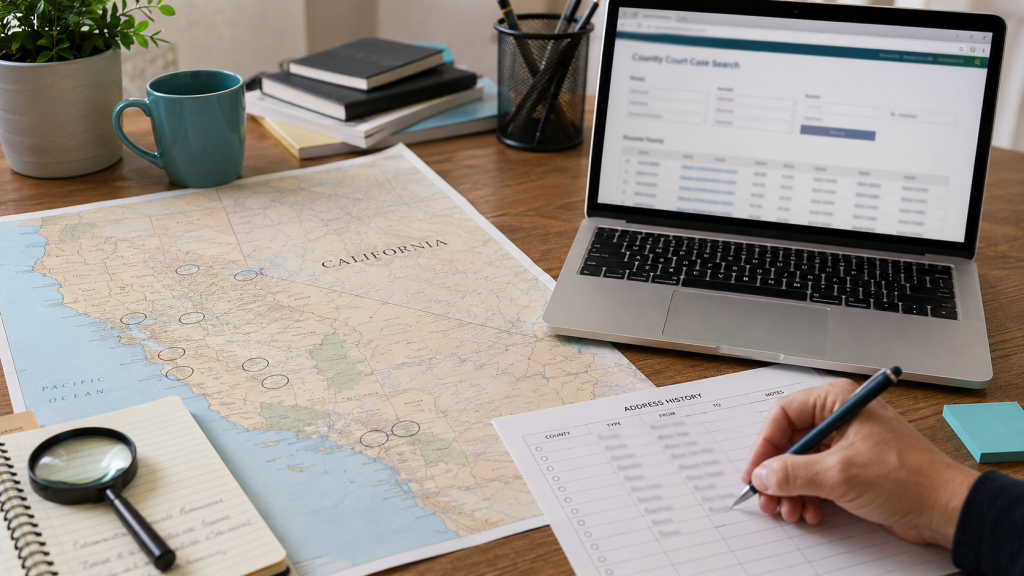
In California, state criminal cases are generally filed through county superior courts. If someone has lived in Sacramento, Placer, and San Joaquin counties, records connected to that person could be spread among three separate court systems. Searching only the person’s current county could miss a case from a former home.
Other states organize their courts differently. Some have municipal courts that serve particular cities. Others have district, county, or justice courts that handle different kinds of cases. This simply means that two criminal matters from the same general area might not be filed in the same court.
Federal criminal cases are separate from state and local cases. Many federal case records can be accessed through PACER, which includes a nationwide federal case index. A search limited to county courts would not cover the federal court system. PACER
This is why there is rarely one source that can promise a person’s complete criminal history.
Commercial background websites may gather information from many places, but those systems also have limits. Their information may be old or incomplete. A result may be connected to the wrong person. A case may appear without its final outcome. A county may not provide information to that particular service at all.
We often think of these databases as places that may offer clues, not as the final word.
The right places to look will depend on what is known about the person. Where has the person lived? Did the person use another name? Are there ties to another state? Is there any reason to consider a federal record?
You do not have to know how to sort through every possible court system yourself. This is one reason people hire a private investigator. We know how to identify the courts and locations that are most relevant without treating a single online search as a nationwide answer.
What Information Is Included in a Criminal Record?
How much you can learn from a criminal record often comes down to two questions:
- What does the court show on its online case index?
- Will the court allow you to obtain the actual case record?
Both answers depend on the court.
In a perfect world, you could enter a person’s name into the court’s website and see:
- The person’s name
- The case number
- The charges filed
- The law connected to each charge
- The reported date of the offense
- The filing and arraignment dates
- Pleas entered by the defendant
- Charges that were reduced or dismissed
- The final outcome of the case
- Jail, probation, or sentencing terms
In some courts, much of this information is available with the click of a button. In many others, it is not.
Some online case indexes show only the person’s name, case number, and filing date. Others may list the original charges but leave out what happened later. If you stop at the online index, you could walk away with severely limited information. You might see that a person was charged with a crime without learning that the charge was later reduced or dismissed.
The next question is whether the court allows you to obtain the actual case record.
We are located in Sacramento County, so we work with Sacramento criminal records often. Sacramento’s online index provides limited details about many criminal cases. However, the court generally allows people to request available documents from the public case file. Depending on the age and type of case, those documents may provide far more information than the online index.
If the full public case record is available, there is a good chance we can get close to the full picture. The documents may show how the case began, what happened as it moved through court, which charges were changed or dismissed, whether the defendant entered a plea, and how the case ended.
If only part of the file is available, we are limited to what those documents tell us. Important pieces may be missing. We might see how the case began and how it ended without knowing everything that happened in between. That can leave parts of the picture unclear.
This is where experience can be especially helpful. Private investigators are familiar with requesting case records from different courts. We also understand common court procedures and can explain what the records mean.
In simple terms, we can often provide a play-by-play of the case. We can explain the original charges, what happened as the case moved forward, whether charges were reduced or dismissed, what plea was entered, and what sentence or final outcome followed.
In some cases, the full story is available online. In others, it can only be found by obtaining the case documents. Sometimes, part of the record is no longer available at all.
As with so many parts of criminal record research, it depends on the court.
How Far Back Do Criminal Records Go?
There is no single number that applies to every court or every criminal record.
You may have heard that criminal records only go back seven years. That is not a dependable rule for determining whether an older court case still exists. Rules about how information may be used for employment or another purpose are separate from the question of how long a court keeps its own records.
A court may keep some criminal records for many years. It may archive older files, move them to another location, place them on microfiche, or destroy certain records after the required retention period has passed.
The type of case can matter too. A court may keep felony records longer than misdemeanor records. An older misdemeanor file may have been destroyed even though a felony file from the same period remains available.
Online access creates another layer of confusion.
Many courts have records that are older than their online systems. A county website may show cases filed from 2005 to the present, while records from the 1980s and 1990s remain available through the courthouse. If you only search the website, it can look as though nothing existed before 2005.
That is why we always pay attention to the dates covered by a court’s online index.
Sacramento County provides a good example. Its current online criminal search covers cases from 1989 forward. The court states that older records may be available through public microfiche. That means a case can be too old for the current online search without being impossible to locate.
The age of the record, the level of the charge, and the court’s retention practices all matter. A very old case might still be available. A different record may have been lawfully destroyed. Another may still exist but only in an archive that takes time to access.
Once again, it depends on the court.
Why Might a Criminal Record Not Appear in an Online Search?
There are many reasons a criminal record may not show up online. Some are related to the court. Others are related to the person or the way the search was conducted.
The person may have used a different name.
That could be a maiden name, a former married name, a nickname, a shortened first name, a middle name used as a first name, or a different spelling. Sometimes the variation comes from an error in the court’s own records.
This is an area where a private investigator’s experience can make a real difference. Investigators have access to professional research tools and know how to identify names and aliases connected to a person over time. That gives us more information to consider when we search the proper court systems.
The age of the case may also explain why it is missing. The case may be older than the court’s online index. It may have been moved to an archive. The public may need to request the file or review older records at the courthouse.
The type of case can matter as well. One court may provide detailed felony information online but very little information about misdemeanor cases. Another may show a list of hearings but no documents. A third may allow online searches only for newer cases.
It depends on the court. It depends on the age of the record. It depends on what that court has chosen, or is legally allowed, to display online.
The search may also be focused on the wrong place. People do not always commit offenses in the county where they currently live. A case might be filed where the person previously lived, worked, traveled, attended school, or regularly visited family.
The record could also be sealed, confidential, or otherwise unavailable to the public. In that situation, the absence of an online result may be correct, even if a case once existed.
Finally, the website or database may simply be incomplete. Information can be delayed, entered incorrectly, attached to the wrong person, or shown without the final disposition.
This is why we are careful with the words “no record.”
When we do not find a criminal record, the most accurate conclusion may be that no record was found under the names, courts, locations, and time periods searched. That tells you what the research covered without making a promise that no record could exist anywhere.
What Does All of This Mean for You?

We know that criminal record research can feel overwhelming. There are many courts, different systems, unfamiliar terms, and no single button that searches everything.
You do not need to sort through all of that alone.
Proven Private Investigators offers criminal history concentrated investigations for clients whose main concern is possible criminal records. We also offer in-depth background investigations when someone needs a wider review of a person’s history.
We can talk with you about what is worrying you, determine which service fits your needs, and explain what the available records do and do not show. Our goal is to replace uncertainty with the clearest, most accurate information that can reasonably be found.
NOTE: This article provides general information only. It is not legal advice. Criminal record access and reporting rules vary by location and purpose. Speak with a qualified attorney if you need advice about how criminal history information may legally be obtained or used.